A man walks into a bar... In this case, a bar on Jonkheren street in Amsterdam (or is it Rotterdam?), where a captive audience is entertained by a hired killer's tale of woe. There is sometimes, perhaps, little difference between the witness and who will be witnessed. Translated from the Dutch by E. M. Beekman.
Bobden Uyl is that next thing to a hit man: a hired writer, one whose works have been translated into German, Russian, Spanish, Bulgarian (!), and of course, English. As the book we're cribbing this from says, "His main theme is travel, from which his characters often return empty-handed or having made discoveries that they did not expect at all." We'll leave it to our listeners to determine whether any of this is to be expected or not. This year Mr. Uyl will be 75 years old, if that makes any difference to anyone.

Friday, January 20, 2006


Monday, January 16, 2006
"The Green Bird" by P. K. Page
Two young people visit the home of two much older people, perhaps not entirely willingly. In the course of their visit, however, at least one of them is profoundly affected by what she encounters there. Read by Scoot.
Patricia Kathleen Page is the grand old lady of Canadian literature, an English-born poet who has been publishing since the early 1940s; although she is a prize-winning poet, she has written fiction, as well. Her first book was The Sun and the Moon in 1944; her latest is 2002's Planet Earth, which has been ranked as one of the fifty most essential Canadian books. Though she grew up on the prairie and spent much time in Brazil, she now lives in Vancouver, British Columbia.
Friday, January 13, 2006
"A Mean Teacher" by Mitch Sisskind
What happens when a teacher is more difficult than her most difficult student? Is there any room for forgiveness here? This rather droll story gives us an unlikely glimpse of modern education (circa 1970). Read by Jonathan Strong.
Mitch Sisskind is a licensed gemologist (believe it or not) who is from Chicago but now lives in New York City; he is a former high-school football coach, and a teacher himself. A collection of his stories, Visitations, was published in 1984 by Brightwaters Press. This particular story was originally published in a 1971 collection of experimental fiction called Anti-Story, which is as fine a guide to what the 1960s wrought in the world of literature as any. One wonders what they call "anti-stories" nowadays. Oops, we forgot--that kind of stuff just doesn't get published anymore!
Tuesday, January 10, 2006
"The Sons of Angus MacElster" by Joyce Carol Oates
Due to popular demand, we finally present a story by American author Joyce Carol Oates, which is in its own way a retelling of Ovid's account of Diana and Actaeon. In this story of violent revenge set on Cape Breton Island, Nova Scotia in 1923, no one is turned into a stag, though a cruel father does meet more than his comeuppance. Read by Scoot.
By 2010 it is estimated that Joyce Carol's collected works will require new annexes in most public libraries and will number in the hundred-thousands. Seriously, it is hard to imagine a more prolific writer (Asmiov, anyone?), one who has to rely on a couple pseudonyms as well to keep her publishers on their toes. From her one-room schoolhouse in rural New York state to her establishment at the solid center of America's literary scene, Oates has entertained and dazzled readers since the 1960s. Our favorite Oates title: You Must Remember This, Because It is Bitter, and It is My Heart, which is even better than her famous story of a girl gone wrong, Where Are You Going? Where Have You Been?
Saturday, January 07, 2006
"Up in the Gallery" by Franz Kafka
Here is the English part of today's bilingual edition, also read by Irmina Haupt. Kafka's story was translated by Willa and Edwin Muir. Time 3:15.
"Auf der Galerie" by Franz Kafka
How about something different today--a bilingual edition? Here is Franz Kafka's little parable in its original German and in its English translation, by Willa and Edwin Muir. Read by Irmina Haupt. Time 2:34.
This tiny squib is one of Kafka's shortest, most dreamlike works, about a circus equestrienne (at last, a chance to use that beautiful word!) who dazzles her audience--and the reader. One feels that the narrator, acting as witness, is brought both to tears and speechlessness by this lovely vision at a public performance.
Irmina Haupt is the pseudonym for a young video artist who has worked and traveled extensively in North America, the Canary Islands, the Middle East, and Europe. Her center of operations is now Munich, where she creates installations for museums and galleries, though probably not like the one in this story! She recently visited the States, though not exclusively to read this story for us; like Kafka himself, she is of Austro-German extraction and apologizes for any confusion due to her semi-Viennese accent. And we think in this description we've been able to mention more geographic locations than any other so far!
Wednesday, January 04, 2006
"Arabella Hardy" by Charles Lamb
An orphaned girl from the East Indies is entrusted to the care of a ship's first mate, who is the object of much merriment to his mates. In this story, presented much like one side of a magazine interview, we are told of a memorable voyage back to England, where the girl learns valuable lessons about human nature and gender stereotyping. Read by Scoot.
The dry facts about Charles Lamb: Born in 1775, the son of a barrister's clerk. A clerk himself in various offices until his retirement in 1825. Best known works the Essays of Elia and his Letters. On a less statistical note, Lamb had an exceptionally unhappy private life which nonetheless did not impede the many stories, adaptations, essays, and poems which flowed from his gentle-spirited pen.
Sunday, January 01, 2006
A new year, a new beginning....
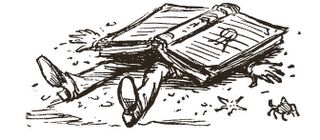
Overbooked!
"Stories to Go" is back. After over two months of computer breakdowns which led to virtual nervous breakdowns, we are glad to finally start publishing again. We will try to stay on a schedule of one story a day every three days, with short descriptions of the story, its author, and its reader (when necessary). Eventually we hope to go back and fill in the gaps of previous stories and dates, providing the information and synopses (however short) of all we've been promising.
Thanks to all the readers who have contributed to this site over the past nine months, which allowed us to rest our voices and provide some much-needed variety here. Thanks most to all the listeners who have been tuning in over the past year--for your support, your good wishes, your kind messages, and your willing ears. As a well-known fast-food franchise used to say, "we do it all for you!"
Sorry to those who have had problems with downloading--these are continuing issues, most often with Apple computers, which are beyond our control. All we can suggest is that anyone experiencing problems retry downloading at another time, stream the story off our site or other sites which link from us, look for the podcast on iTunes, or try another computer. We can't go door to door fixing problems, however much we'd like to give personalized readings everywhere!
"Cities and Memory 1 & 2" by Italo Calvino
In somewhat of a break from a tradition, we present 2006's first title: the first two chapters from Italo Calvino's acclaimed Invisible Cities, which actually does read as much if not more like a collection of short stories than a novel, as it is usually labeled. These pages introduce us to Calvino's complex conception of place and time as shaped by memory, interpreted by Marco Polo!
We have seen Calvino on these pages previously, and we are glad to have him back. Did you know he was the son of two botanists and the brother to a well-known geologist, and that he was born in Cuba? Of course, although he traveled around a great deal, he spent most of his life in Italy. There, he specialized in highly intellectualized works that explore the limits of fiction and the boundaries of science and philosophy. Most important of all was his love of language: "Everything can change, but not the language that we carry inside us, like a world more exclusive and final than one's mother's womb," he once said.
We have been keeping Michael Armstrong's recording in cold storage for some months until we were ready to revamp this site, so we are overjoyed to finally unthaw this offering and serve it to you. Michael Armstrong is a writer and educator who divides his time between England, Italy, and America, where he has worked with both graduate students of English and inner-city children. He is especially interested in understanding the nature of human creativity, so it is no suprise that he reveres Calvino. We thank his for his extreme generosity in taking time out of his busy shedule to read for us.
Saturday, December 31, 2005
Wednesday, December 28, 2005
Sunday, December 25, 2005
Tuesday, December 20, 2005
Saturday, December 17, 2005
Wednesday, December 14, 2005
Sunday, December 11, 2005
Thursday, December 08, 2005
Monday, December 05, 2005
Friday, December 02, 2005
Tuesday, November 29, 2005
Subscribe to:
Posts (Atom)

